



Vom Feld in die Küche: Wissenswertes rund um Spargelanbau und Ernte

From field to kitchen: Everything you need to know about asparagus cultivation and harvesting

Asparagus - Cultivation, Origin & Quality

Asparagus not only has numerous fans, but there are also many fascinating facts surrounding this spring vegetable: Where and how is asparagus grown, what do the different grades mean, and where can you find the best? We have all the questions and answers for the start of the 2019 season.

How long does the asparagus season last?

Depending on the weather, the harvest season begins in early to mid-April. It ends on St. John's Day, June 24th. The reason for the early end to the season is simple: the asparagus plants need to recover and gather strength for the next growing season to ensure a good yield for the following year.

From St. John's Day until the first frost, plants have approximately 100 days to store energy through photosynthesis in the summer sun.

Where does our asparagus come from?

Asparagus is the most widely cultivated open-field vegetable in Germany. The largest growing areas are found in Lower Saxony, Brandenburg, and North Rhine-Westphalia. Most organic asparagus, which has become increasingly popular in recent years, also comes from these regions.

This makes Germany the largest asparagus producer in Europe, and the quality of German asparagus enjoys a good reputation. Spain, Greece, and the Netherlands are other important growing countries. Surprisingly, the world's largest asparagus producer is China!

How is asparagus grown?

Asparagus is a demanding vegetable and requires specific growing conditions. Preparing the soil alone takes 1-3 years. Asparagus thrives in well-fertilized, sandy, and well-aerated soil. From sowing to the first harvest, it takes another year.

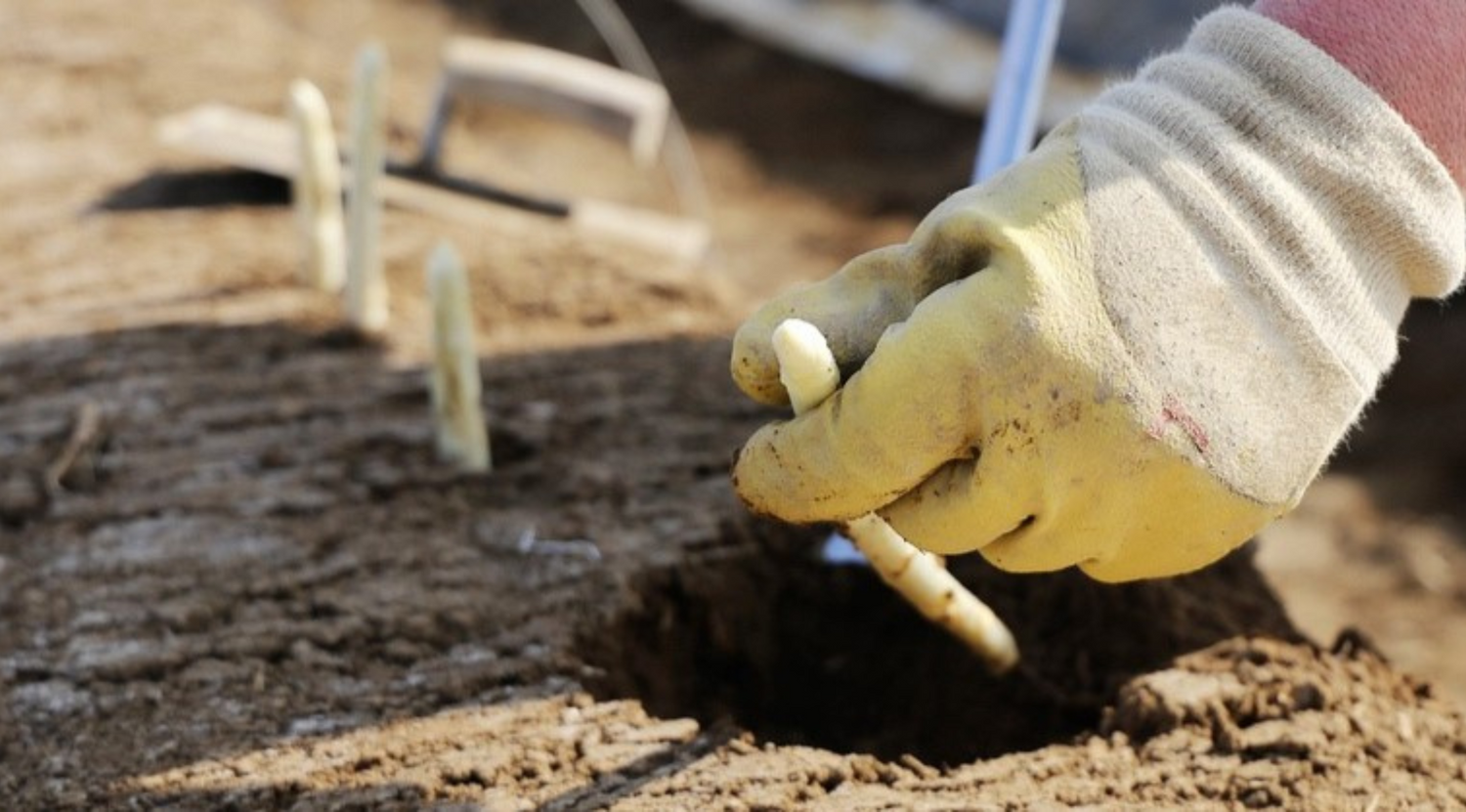
White asparagus plants grow under raised beds covered with plastic sheeting. Green asparagus, on the other hand, is allowed to enjoy the open air and sunshine. While many specialized machines are still used for sowing and growth, the asparagus harvest, also known as cutting, remains entirely manual labor.

What do the trade classes mean?

Asparagus is sold in three commercial grades that describe its quality. The following applies to white or purple asparagus:

Class Extra: The rods in this class have a minimum diameter of 12 millimeters, are straight and have tightly closed heads.

Class HKI: The asparagus has a diameter of at least 10 millimeters, the stalks are only slightly curved, and the tips are tightly closed. Slight discoloration may be present.

Class HKII: In this category, the rods have a diameter of at least 8 millimeters. They are less well-formed and do not have tightly closed ends. More pronounced discoloration may occur.

Since green asparagus is generally thinner, different diameter specifications apply: at least 10 mm for the Extra class and at least 6 mm for the HKI and HKII classes.

Where can you buy good asparagus?

Because asparagus is delicate, it has the best quality when transport routes and storage times are as short as possible. This means: you get the freshest asparagus at the weekly market or directly from the asparagus farm.

When buying asparagus at the supermarket, choose unpackaged, locally grown varieties whenever possible. Incidentally, broken asparagus, which is cheaper, is ideal for soups, as it's just as good as full-length spears.

Image 1: ©Kenny10/istock
Image 2:©no_limit_pictures/istock